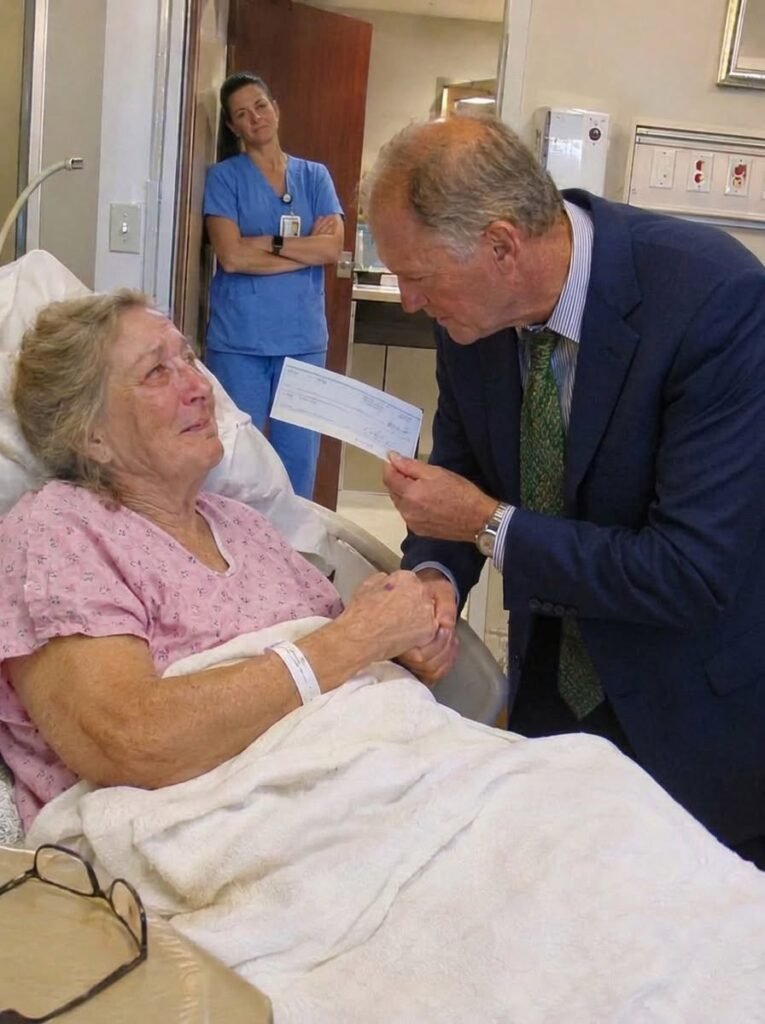
David’s expression hardened instantly.
“Mom,” he said carefully. “You’re confused. It’s the anesthesia. They said this might happen.”
“I’m not confused.”
“You’re not thinking clearly. That’s okay. That’s normal after what you went through.”
“I’m thinking very clearly, David.” I took off my reading glasses. “This gives you the power to sell my house. Today. Without asking me.”
“It’s for your protection!”
“Protection from what?” David said nothing, glancing at Sarah as she lowered her eyes.
A knock interrupted them. Malcolm arrived with his briefcase, accompanied by red-glasses-wearing Gloria Nakamura. Behind them stood an unfamiliar woman in her fifties, wearing silver earrings and a white coat bearing a Swedish Medical Center badge.
“Good morning,” Malcolm said pleasantly. “I hope we’re not interrupting.”
David rose. “Who are you?”
“Malcolm Chen,” he said. “I’m a friend of your mother’s.”
“A friend?” David laughed. “Mom doesn’t have any friends who look like you.”
“Actually,” Malcolm said, “I’ve known her longer than you have.”
Gloria stepped forward. She extended a business card.
“Gloria Nakamura,” she said. “I represent your mother.”
David took the card. He read it. His face went pale.
“Represent her?” Sarah said. “For what? She doesn’t need a lawyer.”
“She does,” Gloria said, “since you filed a petition yesterday afternoon at 4:22 asking the King County Superior Court to appoint David as her emergency guardian and conservator.”
Silence swept the room.
Michael turned slowly from the balloon. “Wait. What? We didn’t file it yet. Bradley said he was going to file it Friday.”
“Michael,” David said sharply.
“You told me Friday!”
“Michael, shut up.”
Gloria opened her laptop bag. She took out a stapled stack of papers.
“Your mother revoked her old health care power of attorney yesterday evening,” she said. “At 6:10 p.m. She’s executed a new one naming someone else. She’s also executed a new financial power of attorney, a new health care directive, and a written instruction to this hospital not to release her records to any of you.”
She set the papers on my tray table, next to the roses.
“And,” Gloria said, “your mother had an independent capacity evaluation at eight-thirty this morning.”
She turned to the woman in the white coat.
“This is Dr. Elena Ruiz. Board-certified in geriatric medicine. Twenty-two years. She’s testified in more than a hundred guardianship cases in this county.”
Dr. Ruiz stepped into the room. She had a calm, no-nonsense face.
“I evaluated Mrs. Davis for ninety minutes,” she said. “Cognitive testing. Executive function. Financial judgment. Memory. Orientation. She scored twenty-nine out of thirty on the Montreal Cognitive Assessment. The one point she missed was because she couldn’t see the picture of the camel without her glasses.”
I almost laughed. It had looked like a dog.
“She understands her finances,” Dr. Ruiz went on. “In detail. She could tell me her monthly income to the dollar. She knows the value of her house. She knows the balance of her savings account. She knows exactly how much she’s loaned to each of you.”
She regarded David.
“In my professional opinion,” she said, “Mrs. Davis has full capacity to make her own medical, financial, and personal decisions. My report will be filed with the court by noon.”
David fell speechless.
“She’s sixty-four,” he said finally. “She just had heart surgery. She’s forgetful. She forgot my daughter’s birthday last month.”
“I didn’t forget it,” I said. “I didn’t have the money for a present because I paid Michael’s truck payment. The lender called me. I called Emma and told her I’d take her for ice cream instead. She was fine with it.”
Michael recoiled.
“And the bills,” David said. “She’s been late on bills.”
“I’ve been late on bills,” I said, “because I’ve been paying your sister’s credit cards and covering your brother’s truck and waiting for you to pay me back sixty thousand dollars.”
He stared at me.
“I’m not forgetful, David,” I said. “I’m broke. Because of you.”
David confronted Malcolm.
“I don’t know who the hell you are,” he said, “but you’ve been filling her head with garbage. You’re some kind of con man. You’ve been working on her. Trying to get your hands on the house yourself.”
“David,” I said.
“No, Mom! Who is this guy? Some rich stranger shows up the day of your surgery and suddenly you have a lawyer and a new power of attorney and…”
“He owns this hospital,” Sarah spoke. Pale and hugging herself near the window, she watched Malcolm as everyone turned toward her.
“Dr. Malcolm Chen,” she said. “Chen Health. I saw his picture on the wall in the lobby on the way in. He owns this hospital. And three others.”
David stopped.
“Why would the owner of a hospital want Mom’s little house?” Sarah said. Her voice was shaking. “Come on, David. Think about it for one second.”
David opened his mouth. He lacked anything to say.
Sarah looked at me. Her eyes were filling with tears.
“I didn’t want to do it, Mom,” she said. “I swear to God. I told David I didn’t want to.”
“Sarah,” David snapped.
“No. No, I’m done.” She wiped her eyes. “David came to me in August. He said you were getting old. He said you were making bad decisions. Giving away money. He said if we didn’t do something, you’d lose the house and end up on the street, and we’d all have to take care of you.”
“I was giving money to you,” I replied under my breath.
“I know.” She was crying now. “I know, Mom. I knew it the whole time. That’s the worst part. He said the guardianship would protect you. And he said that once the house was sold, there’d be enough for your care and some left over for each of us. And I needed it so bad. I’m so far underwater on these cards. I can’t even open my mail anymore.”
“So you went looking at memory care,” I said. “In Everett.”
She flinched like I’d slapped her.
“How do you know about that?”
“Seven thousand four hundred dollars a month,” I said. “Semi-private room. Available November first.”
Sarah put both hands over her face.
“I went to look,” she said through her fingers. “And I sat in the parking lot afterward and cried for an hour. Because there was a lady in a wheelchair in the hallway, and she kept asking everybody if they’d seen her daughter. Over and over. And nobody had.”
“Then yesterday,” Sarah said, wiping her face with her sleeve, “we were sitting in the waiting room. And David got a text from Bradley’s office. And he said, we have to go. Now. If we get the petition in today, while she’s still in the hospital, the judge will grant it for sure. Because she’ll be on drugs and confused, and it’ll look bad.”
She regarded Michael.
“And Michael said what about Mom, she’s going to wake up alone. And David said tell the nurse it’s the parking. She won’t even remember tomorrow.”
Silence followed.
I faced David.
“She won’t even remember,” I answered.
David sank into his chair, head in hands. Michael remained beside the balloon, looking like a child caught breaking a window.
“Ma,” he said. “I’m sorry. I didn’t… David said it was the right thing. He said he’d handle everything. He said I wouldn’t lose the truck.”
“You were going to put me in a home,” I said, “to save your truck.” Michael wept helplessly. Malcolm had watched silently with his briefcase at the door; now he stepped forward and studied my children.
“I’m going to say something,” he replied softly. “And then I’m going to leave, because this is your family and not mine.”
No one interrupted.
“When I was eight years old,” he said, “I didn’t have anything to eat. Every single day. For a whole year. My mother was sick, and we lived in a car for part of that winter. The other kids at school knew. They called me names.”
He regarded me.
“Your mother was sixteen. She was working because her own family didn’t have money. And every day, she put a lunch ticket under my elbow and told me the cafeteria had extras. She spent half of everything she earned. She never told a soul. Not then. Not in forty-six years. She didn’t do it to be thanked. She did it because she saw a hungry kid and she couldn’t walk past.”
He turned back to David.
“That’s who you were going to take to court,” he said. “That’s who you were going to tell a judge couldn’t manage her own life. A woman who’s been taking care of everybody, quietly, her whole life. Including you three.”
He lifted his briefcase.
“I’ve worked in hospitals for thirty years,” he said. “I’ve watched thousands of people die. You know what the ones at the end almost never say? I wish I’d gotten more money. They say, I wish my kids were here.”
He walked to the door. He stopped and looked back.
“She almost didn’t wake up yesterday,” he said. “And you weren’t here.” He left.
Thursday’s eleven-minute hearing took place while I recovered in hospital. Gloria connected her laptop from my tray, with Joyce beside me holding my hand.
Commissioner Patricia Lin reviewed the petition, Dr. Ruiz’s evaluation, David’s revoked authority, my new directives, and nurse Kayla’s declaration concerning my children’s departure. Then she examined Bellevue attorney Bradley Voss, visibly uncomfortable in his costly suit.
“Mr. Voss,” she said. “Does your client wish to proceed with this petition?” Bradley Voss whispered to David, who appeared alone. Sarah had withdrawn her name from the petition Wednesday afternoon; Michael followed an hour later. On my laptop screen, David sat with elbows on knees, resembling Frank when he had lost something and couldn’t recover it. At last he shook his head.
Continue reading on the next page ↓
