I recall staring at the ticket on my kitchenette counter.
The little two-burner stove in the casita. The counter where I kept Harold’s blue mug and a box of Earl Grey tea.
I called nobody.
The towels in my arms.
First, I contacted a lawyer.
Not Daniel’s lawyer or anyone he knew.
I looked one up. A woman in downtown Phoenix. Estate planning and asset protection. Her name was Lorraine Vega. Sixty-two. She had thirty-four years’ experience.
I called her from the casita. With the door locked.
“Mrs. Briggs,” she said. “Have you told anyone?”
“No.”
“Don’t,” she said. “Not yet. Not your son. Not your friends. Not your pastor. Nobody.”
Next, I called another lawyer.
Lorraine recommended him. A tax attorney named Harvey Chen. And a financial advisor named Diane Okafor.
Within days, my legal team was assembled.
They helped me claim the ticket anonymously. Arizona lets you do that now. Through a trust.
They established the trust with me.
Lorraine asked me to name it.
I considered a porch. A blue mug. A wobbly ceiling fan. A piece of mesquite with letters burned into it.
“Second Cup,” I said.
Lorraine wrote it down.
The Second Cup Trust.
Beneath it, a company for buying and holding property.
Second Cup Holdings, LLC.
Most meetings took place on video.
While Daniel and Renee were at work. While the kids were at school. At the little desk in the casita. With the door locked and the blinds closed.
The attorneys advised me to change nothing.
“Don’t buy anything,” Lorraine said. “Don’t move out. Don’t quit doing whatever you’re doing. Not until everything is secured. Not until you know what you want.”
“What do I want?” I said.
Lorraine looked at me through the screen.
“That’s what you need to figure out, Margaret,” she said. “Before anybody finds out you have forty-one million reasons to give them whatever they want.”
So I kept making lunches.
Kept driving the kids.
Kept folding laundry.
Kept cooking four nights a week.
Then came that dinner.
Margaret, my friend Linda’s mother just moved into Sun City Grand. She loves it. They have a pool and a golf course and bingo.
Mom, have you thought about what you want to do long-term? You know, for your own independence?
Margaret, the kids are getting older. Chloe needs her own space. Maybe we could use the casita as a teen room.
Brochures left on the kitchen counter. Encore at Desert Ridge. Vi at Silverstone. The Palms at Scottsdale.
Remarks about needing more space as the children grew older.
Still, I said nothing.
To see if my son would say it to my face.
That night, the conversation finally arrived.
It was a Thursday in October.
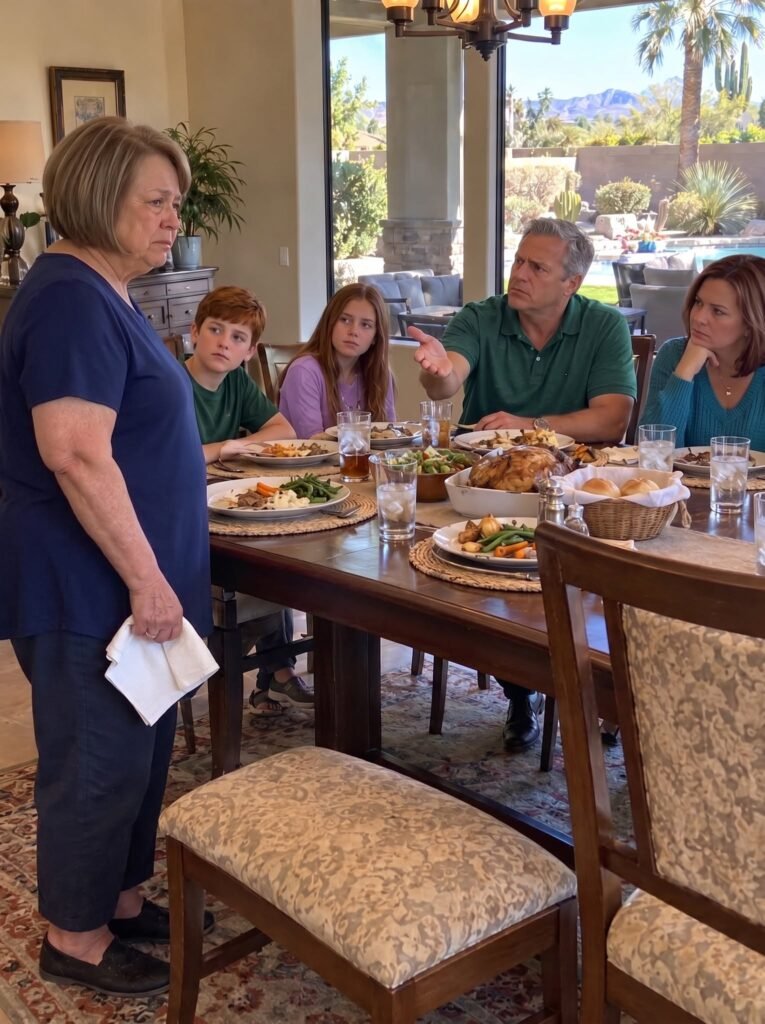
I’d made roast chicken. Harold’s favorite. With lemon and rosemary and little red potatoes around the edges. The way his mother used to make it.
I set it amid the table.
Daniel carved.
Renee poured wine. For herself and Daniel. Not for me. She’d stopped offering me wine months ago.
The children were strangely quiet.
Chloe kept looking at her plate.
Caleb kept looking at his father.
At exactly 6:18 p.m., Daniel pushed back his chair.
I recall the time because the microwave clock was right behind his head. Green numbers. 6:18.
“Mom?” he said.
I looked up.
He glanced at Renee before he spoke.
Just for a second.
She nodded. Very slightly.
“When are you finally planning to get your own place?” Daniel said.
My granddaughter lowered her fork.
My grandson stared at his plate.
They had heard this discussed before.
In the car. At bedtime. Through the walls.
When Grandma moves out, Chloe, you can have the casita.
When Grandma moves out, Caleb, we can get a dog.
I realized everyone at the table had expected this.
Finally.
Like I’d overstayed. Like I’d been told and hadn’t listened. Like I was a houseguest who didn’t take the hint.
I sat there.
Thirty-eight years old. In a polo shirt with his company logo. With a glass of wine in his hand.
The little boy who sat on the porch steps with a juice box sounding out Ev-er-y house needs a porch for the sec-ond cup.
I considered the sign.
On a metal shelf in the garage.
Between the Christmas decorations and the bottled water.
I neatly folded my napkin.
Placed it beside my plate.
And stood.
“Excuse me,” I said.
No tears.
I left the dining room.
Through the kitchen.
Out the sliding glass door.
Outside, the Arizona evening smelled like dust and freshly watered grass.
The sprinklers had just gone off. The lawn was wet. The pool lights were on. Blue and shimmering.
The sun was going down over Camelback Mountain. Pink and orange. The saguaros on the hill behind the house black against it.
I sat down at the patio table.
Under the string lights Renee hung for Caleb’s birthday party.
I had a notebook in my cardigan pocket. A little spiral one. I always carry it. Grocery lists. Soccer schedules. Doctor’s appointments.
I pulled it out.
I opened a blank page.
I listed five things.
1. Move out.
2. Stay calm.
3. Protect assets.
4. Buy a home.
5. Remember this feeling.
I watched number five for ages.
Remember this feeling.
I never wanted to inflict it on anyone else.
Daniel came out about twenty minutes later.
He stood in the doorway. With his hands in his pockets.
“Mom,” he said. “Renee thinks I said it wrong.”
“I didn’t mean it like that,” he said. “I just meant—we’ve been talking. About the future. About what’s best for everybody. You’d be happier somewhere with people your own age. Activities. Independence.”
“Daniel,” I said. “Do you remember the sign on the porch? On Linden Street?”
“What sign?”
“Never mind,” I said.
“I’ll be out by the end of the month,” I said.
He looked relieved.
“You don’t have to rush, Mom,” he said. “Take your time. We’ll help you look at places. Renee’s got a list.”
“I know,” I said. “I’ve seen the brochures.”
I stayed outside until stars appeared.
The following morning I called my lawyer.
Not Renee’s realtor. Not anyone Daniel knew.
Lorraine gave me a name. A woman named Celeste Moreno. Arcadia specialist. She had sold homes in old Phoenix for twenty-six years.
We met that afternoon. At a coffee shop on Indian School Road.
“Willow Creek Lane,” I said. “The craftsman. With the porch and the pecan tree.”
Celeste studied me.
“That one sold,” she said. “Six weeks ago. To an investor. Desert Flip Partners. They’re gutting it.”
“Have they started?”
Celeste checked her phone.
“Permits were filed two weeks ago,” she said. “Demo starts next month.”
“Why that house?” she asked.
“Because my son wanted it,” I said. “And my grandchildren picked out their bedrooms. And my daughter-in-law made a spreadsheet.”
Celeste waited.
“And because,” I said, “it has a porch.”
Celeste looked at me for a long moment.
“Mrs. Briggs,” she said carefully. “Desert Flip paid nine-forty for it. They’re going to want a lot more than that. Before they’ve even done the work.”
“How much?”
“If I had to guess?” Celeste said. “One-two. Maybe one-three. Cash. Fast. They don’t like to wait.”
“Make them an offer,” I said.
Celeste stared at me.
“Mrs. Briggs, I don’t mean to be rude. But do you—”
“Have the money?” I said.
I took out a business card. Lorraine’s.
“Call my attorney,” I said. “She’ll confirm.”
Celeste phoned Lorraine that afternoon.
An hour later she called back.
“Mrs. Briggs,” she said. “I’ll have an offer to Desert Flip by tonight.”
Six days after that dinner, I quietly bought the one house my son’s family wanted more than anything.
One million, two hundred and fifty thousand dollars.
Cash.
Continue reading on the next page ↓
