5 years ago, when Olivia was six, Monica came to me crying. Her husband was finding himself, which basically meant he was moving between classes and part-time jobs without ever settling into a reliable income. Monica was working part-time, too, insisting she couldn’t balance a career and motherhood.
She’d attempted several side businesses, handmade candles, an Etsy shop, a fitness coaching thing, but they all finished with debt.
She told me she only wanted stability for Madison, a secure home, somewhere her daughter could finally feel settled.
It began with her asking whether I could help with a deposit. “Just a little boost,” she said.
Then the real situation emerged. Her credit was damaged from unpaid cards and loans. No bank was willing to approve her mortgage.
So, I did what I believed was the generous thing, the family thing. I purchased the house in my name and allowed her to live there.
It was meant to be temporary, 6 months, perhaps a year, until she and her husband finally got their finances organized.
That was 5 years ago.
They cover the electricity and water. That’s all. I’ve handled every mortgage payment.
And somewhere along the way, the house stopped feeling like mine in their minds.
It became their home, their expectation.
My name might appear on the deed, but in their minds, I was simply the nerd with the money.
“Must be nice,” Monica once remarked when I mentioned a work project. “Just sitting at a computer all day. You wouldn’t even know what to do with that money if you weren’t helping us.”
I brushed it off. That’s what I do.
But later that evening, I stared at the ceiling and wondered, “Maybe she’s right. Maybe I’ve been paying for acceptance this entire time.”
Of course, I never spoke those words aloud. It was easier convincing myself I was simply helping. That’s what family does, right?
And for some time, it worked. Or at least I allowed myself to believe it did.
Adam never approved of it. He’s too considerate to say I was being taken for granted, but I could see it in his eyes.
Every month when the mortgage payment disappeared, every holiday when we arrived carrying gifts while Monica barely offered thanks, Adam would glance at me like he was waiting for me to finally react.
I didn’t because deep inside I believed maybe this was the cost of belonging.
By then, Olivia was already part of our world.
She and Madison were just months apart in age, growing up alongside each other. Olivia was quiet, thoughtful, happiest with a book in her hands or a Lego set scattered across the floor. Brilliant, but shy, socially awkward, much like Adam and me.
In other words, an easy target within this family.
At first, I persuaded myself everything was fine. Kids tease, families sometimes play favorites. It wasn’t exactly like what I experienced.
Except it was.
At Thanksgiving, Olivia tried telling a story about her science fair project. Monica interrupted her mid-sentence. “Let Madison finish first.”
Everyone nodded as though it were completely normal.
Another time, Olivia brought along a robotics kit she’d made. She explained how the sensors operated, her eyes glowing with excitement. Mom smiled, patted her head, and then instantly turned toward Madison. “Show us your cheer routine.”
The room filled with applause and praise.
Olivia sat down silently, twisting her hands together, pretending she didn’t mind.
I noticed it. I felt it. And I convinced myself it wasn’t serious. That I was imagining things. That history wasn’t repeating.
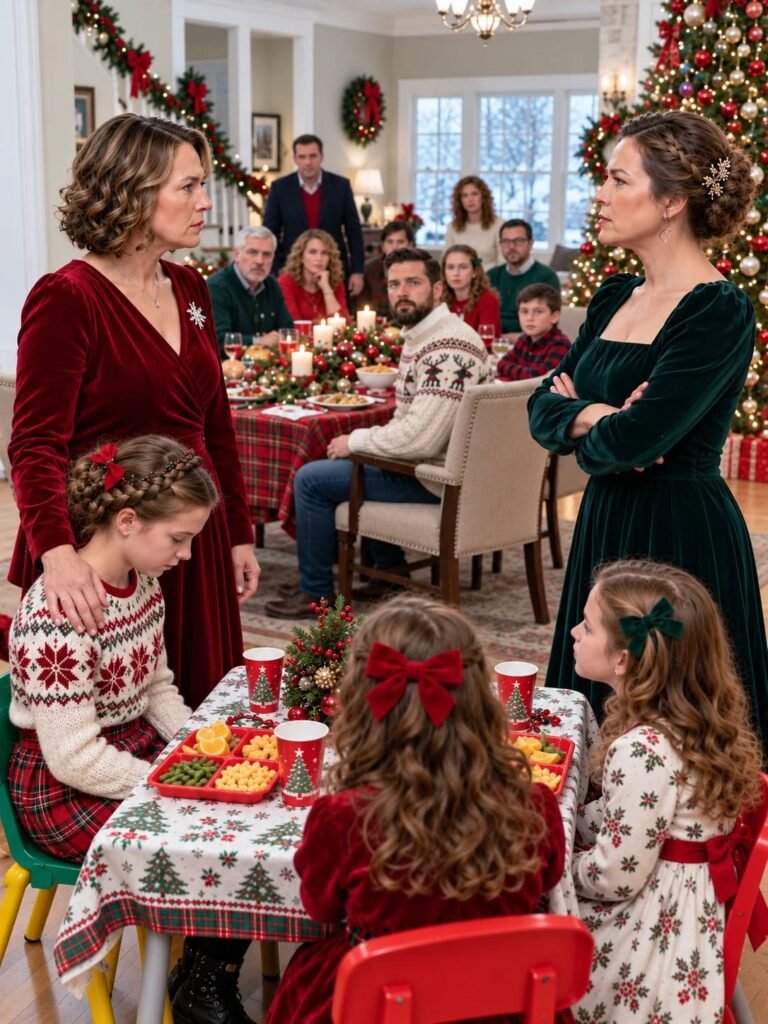
But after Christmas dinner, I couldn’t deny it anymore.
Something inside me changed that night. I wouldn’t stand quietly, tray in hand, while Olivia became their newest punchline.
Not anymore. It ends here.
The drive home carried the heavy kind of silence. The kind that isn’t peaceful, only uncomfortable.
Adam kept his attention on the road. Olivia stared through the window, her breath clouding the glass. I sat in the passenger seat with my arms folded so tightly I could feel my fingernails pressing against my skin.
Adam tried once, halfway down the block. “What’s going on?” he asked, his voice cautious, like he was carefully testing the temperature of boiling water.
“Later,” I said, my throat felt too tight to discuss it.
He nodded, but I could sense his confusion moving around the car like static. Nobody spoke again.
By the time we reached the driveway, my jaw hurt from clenching it.
Inside, Adam dropped his keys into the dish beside the door and turned toward me. “Okay,” he said. “What was that?”
I removed my coat and hung it carefully because if I moved too quickly, I’d probably snap it straight in half.
“They were mocking Olivia.”
He frowned.
“Mocking her openly in front of everyone. It wasn’t teasing, Adam. It was deliberate hum!liation.”
His eyebrows lifted. “I didn’t hear anything like that. I honestly thought they were playing some silly game.”
“Exactly.” My voice stayed flat, sharp. “They believed it was a game, too.”
Adam looked stunned.
He’s always been the peacekeeper, the person smoothing over awkward moments at family gatherings while I carried trays. He couldn’t quite understand that we’d just ended Christmas over something he hadn’t even heard.
Before I could explain more, Olivia spoke for the first time since we left that house.
Her voice was small, the kind of voice that makes you lean closer because it sounds as though it might disappear.
“It was just a joke.”
I turned around. She was standing beside the couch, still wearing her coat, staring down at her shoes. Her words hurt deeper than anything Monica had said all evening.
“If I walked away whenever people made jokes about me, I’d have no friends,” she added, almost whispering.
That was the moment something inside my chest cracked because I recognized it. Word for word, thought for thought. It was me, 11 years old, absorbing every remark my family threw my way and convincing myself it was normal.
Adam rubbed his forehead, still confused.
“Olivia, what kind of jokes?”
She hesitated, then her lower lip trembled. “They said Madison’s smarter than me, funnier, better, that I’m annoying.”
The word remained suspended in the air like a warning.
She blinked hard and quickly added, “But it’s okay. It’s probably true. She really is smarter than me.”
Her voice cracked on that final word, and it nearly broke me.
I crouched down before her, holding her cold hands in mine. “None of that is true,” I said, steady but firm. “They weren’t being truthful. They were being unkind. Jokes that hurt people aren’t jokes.”
She shook her head, tears shining but refusing to fall. “But if I can’t handle it, maybe I am weak. Maybe they’re right.”
I wanted to shout.
Not at her, at them. At every one of them who’d taught her to believe cru:elty was some test she needed to pass.
Instead, I took a breath.
“No,” I said as calmly as I could manage. “You are not weak. You are kind. You are brilliant. And people who make you feel small don’t deserve you ever.”
Her lips trembled. The tears finally came then, falling quickly like she’d been holding them inside for hours. She buried her face against me, her little body shaking.
Relief. That’s what it was: relief that someone was finally giving her the truth.
She didn’t have to accept it.
I held her until her breathing settled until the storm inside her faded.
Later, I tucked her into bed. She was quiet, thoughtful, still processing everything.
But I noticed something shift in her eyes. A seed planted.
When I returned to the kitchen, Adam was leaning against the counter, arms folded, looking like he wasn’t sure whether he should be angry or bewildered.
“You’ve always said yes to them,” he said. “Always helped, always tried to keep the peace.”
“What changed?”
“That version of me is gone.”
I pulled out a chair and dropped into it. “I kept saying yes, hoping someday it would matter. It never did.”
He paused.
“But the house, they’re finished.” My voice was cold. “I want them gone.”
He studied my face. “Are you certain? That’s a major step.”
I held his gaze. “I’ve never been more certain about anything.”
For a second, he looked like he might disagree. Then he sighed, his shoulders lowering.
“Okay.”
That was everything I needed.
I pulled my laptop across the table. The light from the screen illuminated the kitchen as I wrote the letter. It was brief, professional, firm.
Continue reading on the next page ↓
