We submitted the documents and complaints to the district attorney. Investigators and courts, rather than my orders, would decide what happened to Walter, Russell, and Tiffany. Walter lost control of the family finances, his signing privileges were suspended, and efforts to recover the diverted money began. Diane agreed to testify about her payment. I also disclosed to Priscilla my own choices and illegal underground dealings, which needed to end and face examination. I couldn’t insist on honesty while protecting my double life.
Correcting financial records proved simpler than becoming a responsible father. No accountant could calculate the time I had lost with my children, and no payment could instantly make them comfortable with a stranger who happened to be their father.
When Megan first placed Mason in my arms, my stiffness frightened him into crying. Bryce watched suspiciously from the stroller. She demonstrated bottle preparation, diaper changes, and how to tell when they needed sleep. She offered no praise for these ordinary parental duties, and I hadn’t earned any.
We arranged legally valid paternity testing and formal acknowledgment of Mason, Bryce, and Hazel. Through family-court guidance, we agreed on child support, gradually increasing visitation, and shared medical expenses. I proposed buying Megan a house; she declined.
“I’d rather have a place in my own name and an agreement I can enforce without asking you for favors.”
I respected her decision, made the required payments, and kept every visit on schedule. If she said our time was finished, I left.
Two months later, we traveled to Memphis together. Gladys welcomed us cautiously; she’d spent countless nights monitoring Hazel. The little girl sat among stuffed animals on a blanket, a delicate scar visible across her chest.
“Don’t pick her up yet,” Gladys warned. “Let her get used to you.”
I knelt beside the blanket.
“Hi, Hazel. I’m Garrett.”
After studying me, she extended a yellow rubber duck. I took it, unable to speak. When tired, she reached for Gladys, and I let her.
Hazel continued seeing cardiology specialists. Josephine’s trust ensured treatment and access to the family house during recovery, free from dependence on my temper or wealth. Eventually I read my grandmother’s full final letter to her attorney. It concluded: “Listen to Megan before you try to win back what you never should have thrown out.”
As the months passed, the twins learned to walk and Hazel spent increasingly long periods in Nashville. Diane met Lorraine, my father’s other daughter, without pretending one lunch could repair decades of silence. Tiffany moved away while remaining answerable for her actions. Restitution proceeded slowly. I ended my underground businesses, accepted their investigation, and placed my legitimate company under external oversight.
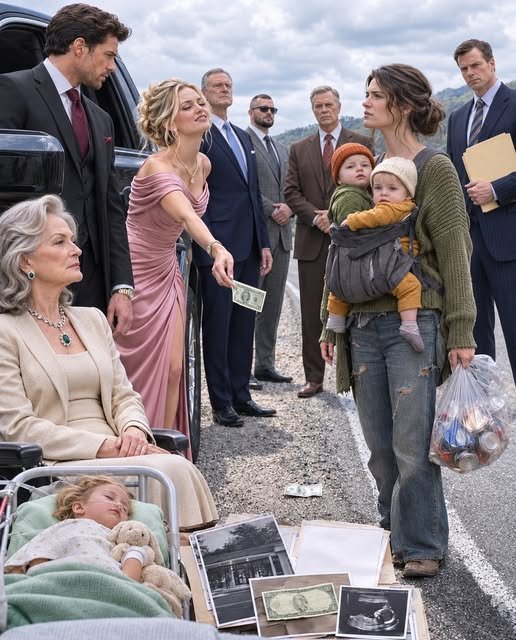
Megan resumed her auditing career. She no longer collected cans beside the highway. When I mentioned our roadside encounter, she smiled slightly.
“I picked up Tiffany’s twenty after you drove off. I bought formula. Not because she told me to, but because my kids were hungry.”
I had no adequate response. The money Tiffany had thrown down to humiliate Megan had, in the end, bought something the children genuinely needed. Megan had placed their hunger above her pride, just as she had always placed their safety first.
When Mason and Bryce turned two, we celebrated with Gladys, Tammy, and friends. Megan agreed that we could gradually get acquainted again, with no assurances of remarrying. After putting the boys to sleep, we sat together in Josephine’s garden.
“Do you still think about the highway?” she asked.
“Every day.”
“I don’t anymore.”
I looked at her in surprise.
“I don’t want that moment to decide the rest of our lives,” she explained. “But I don’t want you to forget it, either.”
She held my hand. This wasn’t unconditional forgiveness; it was a choice we remained free to reconsider.
Later, we converted part of Josephine’s home into short-term accommodation for families whose children needed cardiac treatment, keeping publicly audited accounts. Gladys helped create the program, while Tammy assisted visiting families. Megan insisted that contributions never entitle donors to gratitude or obedience. She was right.
One afternoon, we revisited that same stretch of Tennessee highway. Our three children slept safely in car seats while we stood beside our vehicle. I looked toward the spot where Tiffany had dropped the twenty-dollar bill.
“I thought you were the one who had lost everything,” I confessed.
Megan looked at our sleeping children.
“I was scared, Garrett. Terribly. But I knew who the people were who loved me.”
I finally understood the pity in her eyes. She had lacked money, but not affection. I’d possessed houses, obedient men, and a woman willing to marry me, without truly knowing any of them—or myself.
We hadn’t returned to erase the suffering. We returned because I could finally choose to remain beside my family instead of abandoning them again.
