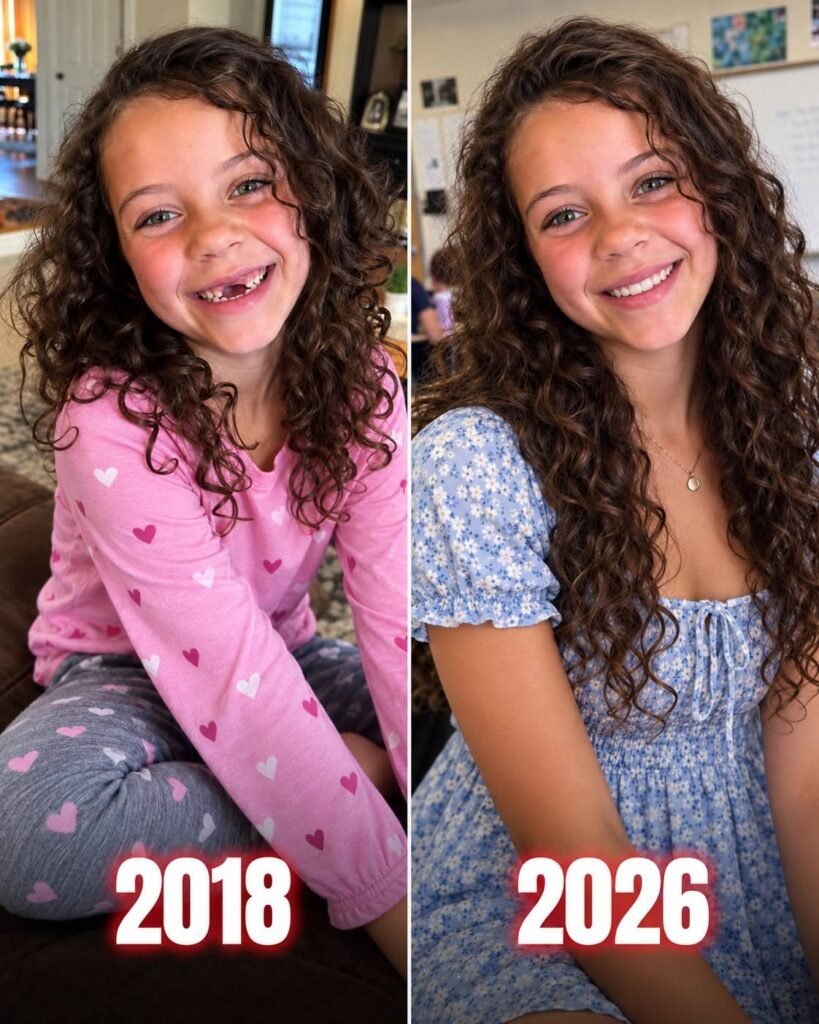
Eight years had passed since I buried my only daughter.
People like to say that time heals grief.
I don’t think that’s true.
Time teaches you how to live beside it.
It teaches you how to get out of bed when the person you love is still gone. How to answer ordinary questions. How to laugh without immediately feeling guilty. How to walk past a child’s bedroom without reaching for a doorknob that hasn’t been turned in years.
But grief doesn’t disappear.
Mine simply learned to be quiet.
My daughter, Maggie, was eight years old when she woke one morning with a fever.
She shuffled into our bedroom wearing her yellow pajamas and stood beside me with her hair tangled around her face.
“Mom,” she whispered, “my legs feel really heavy.”
I was awake instantly.
Paul lifted his head from the pillow Within an hour, we were at the hospital.
At first, no one seemed frightened.
Children got fevers. Children became weak. Doctors ordered tests, nurses smiled, and everyone kept using words like precaution and observation.
Then one test became five.
Five became twenty.
Specialists started appearing.
The smiles became tighter.
Nobody wanted to tell us they were worried, but Paul and I could see it in the way doctors gathered outside Maggie’s room.
For twelve days, we waited for an answer.
Every morning, I convinced myself that this would be the day someone walked through the door and said, We figured it out.
Instead, on the twelfth day, our daughter died.
There was no satisfying explanation.
There was no single disease I could learn to hate.
Her death certificate contained medical terminology, but none of those words explained how a laughing eight-year-old could disappear from our lives in less than two weeks.
For a long time, anger was easier than sorrow.
I blamed the doctors.
I blamed the hospital.
I blamed myself for every decision I had made during those twelve days.
And I hated anyone who tried to comfort me by saying Maggie was somewhere better.
There had been nowhere better for my daughter.
Her best place had been our kitchen, stealing strawberries while I cooked dinner.
Her best place had been curled between Paul and me during movie nights.
Her best place had been home.
With us.
After Maggie died, Paul and I never had another child.
Two years later, he asked me about it once.
We were lying in bed when he quietly said, “Do you ever think about trying again?”
I stared into the darkness.
“I can’t.”
There was a long silence.
Then Paul reached for my hand.
“Then we won’t.”
That was the end of the conversation.
We became a family of two.
Not the family we had imagined.
Not the family we had planned.
But somehow, eventually, still a family.
Years passed.
I stopped crying every morning.
Then I stopped crying every week.
Eventually, I could hear Maggie’s name without feeling as though someone had wrapped a hand around my throat.
That was when I decided to return to work full-time.
I became an English teacher at a local high school.
To my surprise, I loved it.
Teenagers were chaotic, dramatic, sarcastic, impulsive—and often far more thoughtful than adults expected them to be.
They filled my classroom with noise.
For years, silence had followed me everywhere.
I hadn’t realized how much I needed noise.
Then, one Tuesday morning in October, there was a knock on my classroom door.
And everything I thought I had learned about living with grief suddenly came apart.
I was writing an essay question on the board when someone knocked.
“Come in,” I called.
The door opened.
“Sorry I’m late. I’m Lily.”
I turned around.
The marker fell from my fingers.
For several seconds, I forgot where I was.
A sixteen-year-old girl stood in the doorway.
Dark curls framed her face.
Her eyes were a strange gray-green.
There was a tiny crease near the left side of her mouth when she looked uncertain.
Then she lifted one hand and tucked a curl behind her left ear.
My stomach dropped.
Maggie used to do that.
Whenever she was nervous, embarrassed, or trying desperately not to laugh, she would push her hair behind that same ear.
I stared at Lily.
She wasn’t identical to the eight-year-old daughter I remembered.
That would have been easier.
Instead, she looked like an answer to a question I had spent eight years trying not to ask.
What would Maggie look like now?
Lily shifted awkwardly.
Her eyes dropped to the marker on the floor.
Then back to me.
“Are you okay?”
“Yes.”
The word came out too quickly.
I bent down to retrieve the marker so she wouldn’t see my hands trembling.
“Yes. Sorry. You’re the new transfer student, right?”
She nodded.
“Lily.”
I assigned her a seat in the third row and continued teaching.
At least, I think I continued teaching.
My mouth moved.
Words came out.
I wrote things on the board.
Students answered questions.
But my mind kept returning to the girl sitting in the third row.
Every glance in her direction hurt.
When lunch finally came, I locked myself inside a bathroom stall and cried silently into my hands.
I felt ridiculous.
Ashamed, even.
This child had done nothing.
She had simply walked into a classroom.
After several minutes, I washed my face and stared at my reflection.
“She is not Maggie,” I whispered.
Another teacher was washing her hands nearby and glanced toward me.
I pretended I had said nothing.
That evening, I almost told Paul.
But something stopped me.
Perhaps I was afraid he would think I had lost my mind.
I waited until the next night.
We were halfway through dinner when I finally said, “There’s a new student in my second-period class.”
Paul looked up.
“Okay.”
“She looks like Maggie.”
His fork froze halfway to his mouth.
Only for a moment.
But I noticed.
Something crossed his face before sorrow replaced it.
I immediately tried to soften what I had said.
“Not literally, obviously. I don’t know exactly what Maggie would look like at sixteen. But this girl has her eyes. And sometimes when she’s thinking, she makes the same expression.”
Paul slowly placed his fork down.
“Rachel, please.”
I frowned.
“What?”
“Don’t do this.”
“I’m not doing anything.”
“You’re taking some girl you barely know and turning her into Maggie.”
The exhaustion in his voice hurt more than anger would have.
“I know she isn’t Maggie.”
“Then leave it alone.”
I reached across the table.
Paul pulled his hand away.
That hurt too.
“Every time you tell me she looks like Maggie,” he whispered, “it feels like I lose our daughter all over again.”
After that, I stopped mentioning Lily.
But I couldn’t stop noticing her.
For illustrative purposes only
Continue reading on the next page ↓
