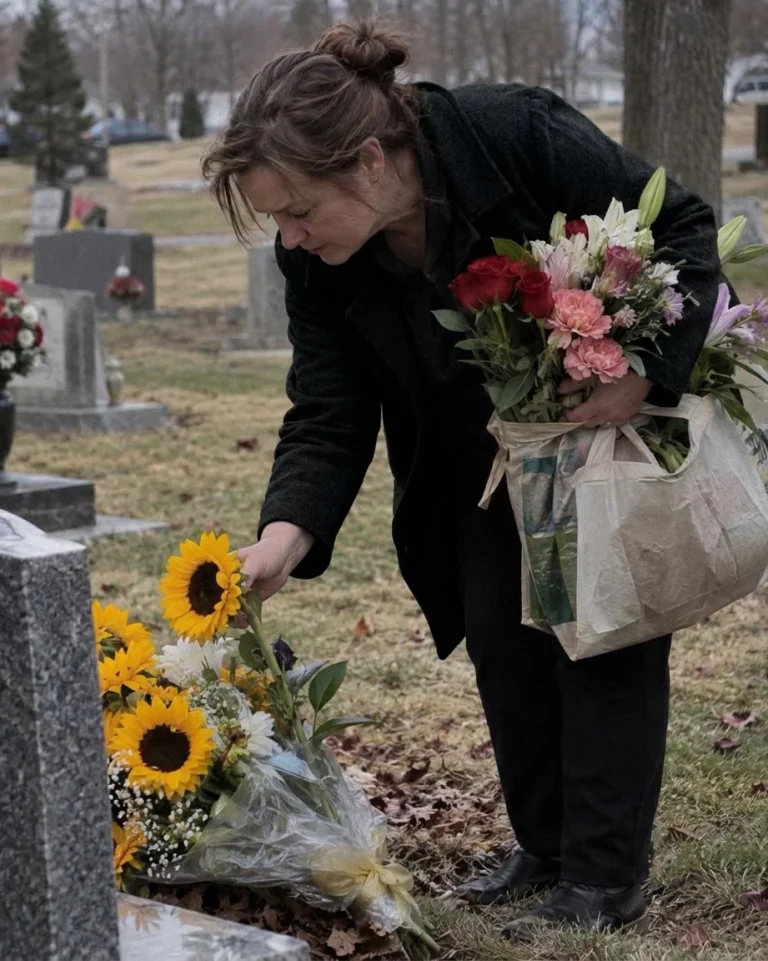
My pruning shears were still near Edward’s headstone when I saw a stranger holding the sunflower I’d brought for his birthday. Her shopping bag overflowed with flowers gathered from other graves. I demanded she return mine. Instead of explaining, she invited me across the street, where a locked room held something marked with my dead son’s name.
Yesterday should have been Edward’s thirty-fifth birthday. I bought sunflowers rather than a birthday cake, remembering how he used to arrive at my house with a bunch of them. He never bothered with a vase or fancy wrapping. They came in supermarket plastic, wedged beneath his arm beside his toolbox.
“For the prettiest girl on the block,” he’d say.
“You’re only saying that because you want lunch.”
“Can both things be true?”
I’d generally make him a sandwich.
Seven months earlier, Edward had been killed in a traffic accident while driving home from work. Even now, whenever something stopped working, I sometimes instinctively reached for my phone to call him.
On his birthday, I arranged the sunflowers in a small vase beside his grave.
“The kitchen faucet’s leaking again, Eddie,” I told him.
His familiar response seemed almost audible.
“Mom, why didn’t you just call me?”
I remained there until the wind turned chilly, then returned home. Only that evening did I realize my pruning shears were still beside his headstone.
The following morning, I went back to retrieve them. Halfway along the cemetery’s gravel walkway, I spotted a woman wearing a shabby gray coat and carrying an oversized shopping bag. Roses, carnations, and unopened lily buds protruded from it. I saw her lean over a grave and pull a pink carnation from a newly placed arrangement. She dropped it into her bag, then proceeded to another grave, selecting a white rose and some greenery. These weren’t wilted flowers abandoned for disposal. She was deliberately taking fresh ones. Water seeped from the bag onto her footwear.The sight left me standing motionless in the middle of the walkway. I could think of no innocent reason for choosing the newest blossoms from several memorials. I assumed she intended to sell them. Then she headed straight toward Edward’s resting place, bent over, and removed a sunflower from yesterday’s bouquet.
“Don’t touch that.”
She startled and turned, the flower still in her grasp. I approached immediately.
“Give it back.”
She surrendered it without arguing. From nearby, she appeared roughly my age, possibly younger. Her coat cuffs were worn and her fingers wet.
“How many graves have you taken those from?”
Her gaze dropped.
“I’m sorry.”
“I brought these for my son yesterday.”
I moved closer.
“It was his birthday.”
She glanced at the inscription.
“I’m very sorry.”
“Are you?”
When she remained silent, I tightened my hold on the stem.
“This is all I can do for him now.” My fingers closed around the sunflower stem. “And you’re taking them to sell?”
She looked up sharply.
“I’m not selling them.”
“Then what are you doing?”
Her eyes settled on the flower I’d recovered.
“Please follow me. You need to see something.”
The request seemed absurd.
“You expect me to go somewhere with you?”
“I live across the street.”
“That doesn’t explain why you’re stealing flowers.”
“I know.” She tightened her grip on the bag. “I can show you.”
I examined the crowded stems.
“You’re putting every one of those back.”
“I will.”
“Now.”
She paused.
“Please. Ten minutes. Then I’ll bring them back, and you can come with me.”
I disliked her proposal, yet leaving without understanding her behavior felt worse. Across the road were houses, with occasional vehicles passing. At least we wouldn’t be completely isolated.
“What’s your name?” I asked.
“Monica.”
“I’m Sansa.”
She acknowledged that with a nod. Clutching the sunflower against my coat, I agreed.
“All right, Monica. Show me.”
Her modest home had weathered blue shutters and a slim porch. She guided me past a neat sitting room to a locked door at the hallway’s end, then produced a key.
“What’s in there?” I asked.
She met my eyes.
“The reason I took the flowers.”
She turned the lock and switched on the light. I stopped at the entrance.
One wall was lined with shelves displaying small objects inside wooden presentation boxes, covered in white fabric. Handwritten tags beneath them listed dates or names. Under the window stood a workbench scattered with dried petals, molds, gloves, and bottles of transparent casting resin.
“What is all this?”
Monica hesitated. Before she replied, I noticed one label on the second shelf: Edward. His full name appeared carefully handwritten beneath it.
Continue reading on the next page ↓
