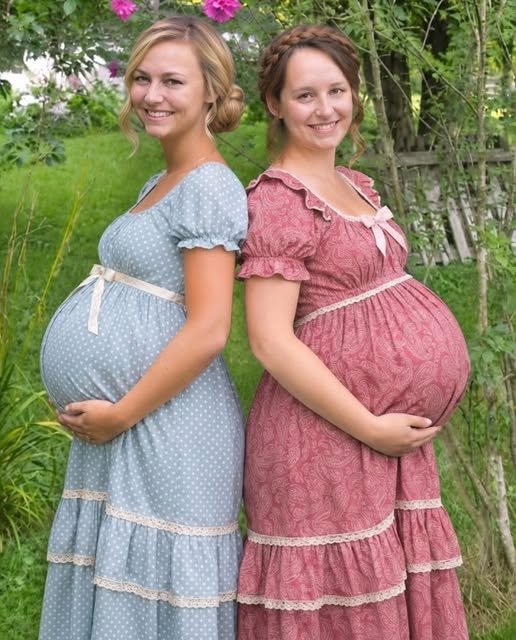
That afternoon, Emily and I went to Margaret’s house.
Helen was already there.
Both women looked exhausted.
On the coffee table sat an old wooden box filled with photographs, letters, and documents.
“No more lies,” I said.
Margaret nodded.
Then she opened the box.
Inside was a little blue ribbon.
The moment I touched it, an old memory returned.
A woman tying it around my wrist.
A birthday cake.
A warm kiss on my forehead.
“Rebecca gave me this,” I whispered.
“On your seventh birthday,” Margaret confirmed.
She showed us another photograph.
Rebecca sat on a porch holding a baby.
A little girl stood beside her.
It was me.
The baby was Emily.
We had been sisters long before we became neighbors.
Margaret explained that Rebecca was her younger cousin.
She’d married Daniel Whitmore at twenty-two.
At first, he appeared charming and devoted.
But after their daughters were born, he became increasingly controlling.
He monitored Rebecca’s spending, questioned her friendships, and discouraged her from working.
Eventually, she began secretly preparing to leave.
She stored important papers with Margaret and saved money whenever possible.
One evening, Daniel discovered her packed suitcases.
They argued.
A neighbor called for help.
Rebecca escaped with both children, but Daniel drove away before authorities arrived.
Later that night, his car was discovered near a flooded river.
Damaged barriers and tire marks suggested he’d driven into the water.
Despite an extensive search, no body was recovered.
Investigators eventually concluded that he’d probably died.
But Rebecca never fully believed it.
Several weeks later, she received an anonymous letter.
It contained a frightening message:
“You cannot keep my daughters from me.”
Rebecca became terrified.
She checked windows repeatedly and refused to let us play outside alone.
Then, only months later, she developed a severe infection.
She died at twenty-nine.
Margaret and Helen became our legal guardians, each taking responsibility for one child.
They moved to neighboring houses and allowed us to grow up together.
But they never explained that we shared the same biological parents.
“We wanted you to have ordinary childhoods,” Helen whispered.
“Ordinary childhoods built on lies?” Emily demanded.
Neither woman could defend the decision.
Then Margaret handed us a letter Rebecca had written.
It was addressed to her daughters.
She told us that we were the greatest joys of her life.
She wanted us to know we’d always been loved, regardless of who raised us.
And she warned us never to confuse fear with love.
I read the letter through tears.
For the first time, our biological mother was becoming real.
But another question remained.
How had our father’s name appeared in the fertility clinic’s records?
Emily and I contacted Dr. Harrison and requested a formal investigation.
We also hired an attorney experienced in medical records and reproductive care.
We weren’t interested in speculation.
We needed evidence.
The clinic arranged independent genetic testing while preserving its archived documents.
Our mothers provided our original birth certificates.
Both listed the same parents.
Rebecca Whitmore.
Daniel Whitmore.
Soon afterward, laboratory testing confirmed that Emily and I were full biological sisters.
The friend who’d brought cupcakes to my door twenty-five years earlier had been my sister all along.
Yet the donor mystery remained unresolved.
The clinic discovered that its reference records were linked to an old fertility storage program associated with Dr. Daniel Whitmore.
The name belonged to our father.
But the donor profile we’d selected described a different, younger man.
The archived files contained conflicting information.
Dr. Harrison warned us against reaching conclusions without reliable genetic comparisons.
Meanwhile, another envelope arrived at my apartment.
Inside was a copy of a letter Rebecca had written shortly before her death.
It mentioned Daniel’s efforts to control decisions affecting their family.
We preserved the documents and notified our attorney.
Then an unfamiliar woman called.
“My name is Laura Bennett,” she said. “I knew Rebecca.”
Laura explained that she’d sent the first photograph after seeing our pregnancy announcement online.
She’d recognized us from pictures Rebecca had kept years earlier.
A few days later, Emily and I met her at a quiet café.
Laura brought photographs of Rebecca laughing at picnics, celebrating birthdays, and playing with us as children.
She told us Rebecca loved detective novels, thunderstorms, and yellow dresses.
She’d dreamed of opening a bookshop.
Hearing those details meant more than I expected.
Our mother was no longer just a tragic figure in an old photograph.
She had been a real woman with dreams, humor, and extraordinary love for her daughters.
Laura also brought another letter.
Rebecca had written that Daniel once had access to a medical program involving long-term biological sample storage.
She worried that he might use those records to interfere with the family’s future.
The letter didn’t prove he’d survived the river accident.
But it explained why his identity might appear in archived fertility documents.
A week later, Dr. Harrison requested another meeting.
This time, he had more significant information.
The independent laboratory confirmed that the same biological donor had been used for both pregnancies.
However, additional testing suggested an unexpected genetic relationship between that donor and both of us.
“What kind of relationship?” I asked.
The doctor hesitated.
“The findings are compatible with a parent-child relationship.”
The room went silent.
Emily began shaking.
I placed both hands over my stomach.
Our biological father might also have been the donor used to conceive our children.
Continue reading on the next page ↓
