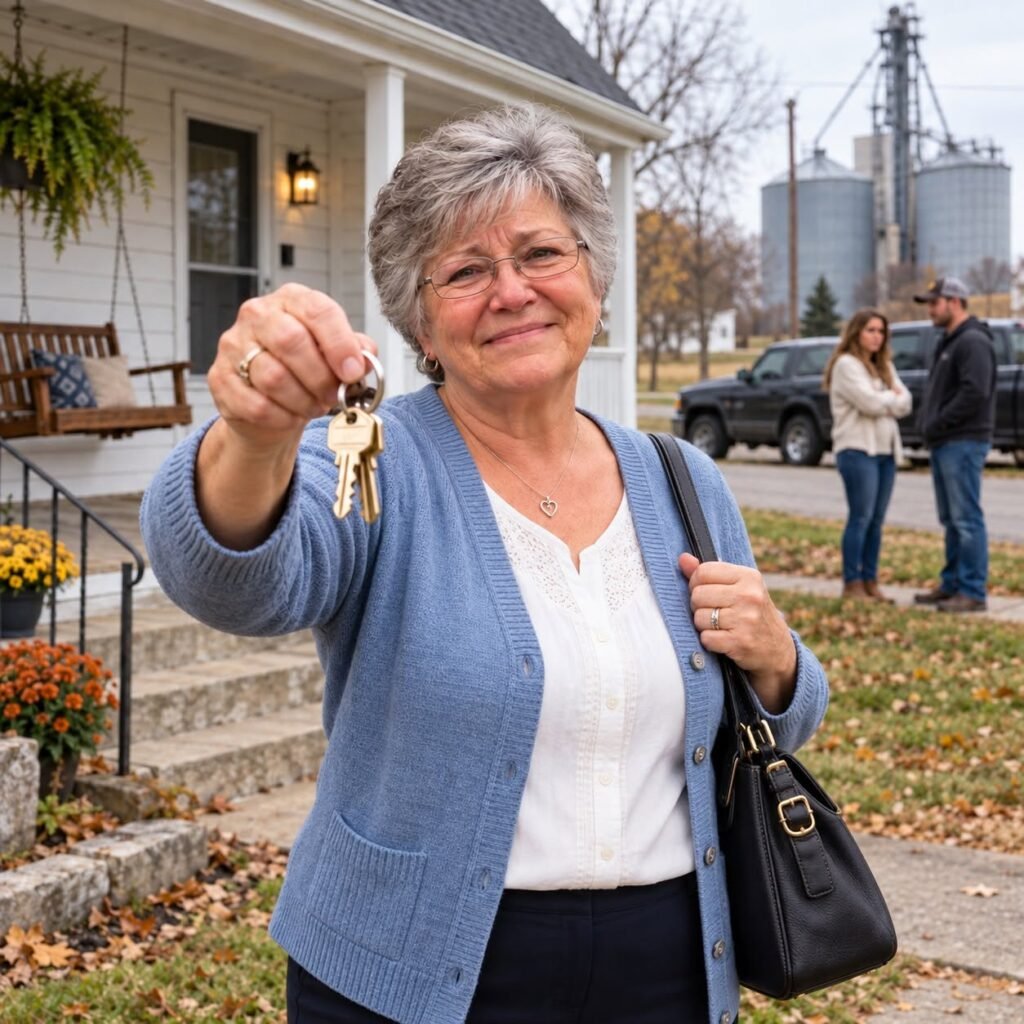
My daughter wanted $800 a month and four free days of babysitting a week for a damp basement room, and I smiled, said thank you, and quietly rented a little house for $550 instead. That is the short version. The long version began on a Saturday afternoon, right after lunch, at Michelle’s kitchen table, when her husband, Todd, pushed a sheet of notebook paper across the oilcloth toward me without saying a word.
One figure sat in the middle of the page. $800, with two circles drawn around it, the second pressed so hard the pen had nearly gone through. “That covers your room, the utilities, and part of the groceries,” Michelle said, folding a dish towel into smaller and smaller squares. “And you’d watch the kids four days a week, Mom. That way you’re contributing something.” Contributing something. I am sixty-seven years old. I raised that girl on what her father earned as a hired hand, and I kept the books at the lumberyard for twenty-two years, and nobody ever suggested I wasn’t contributing.Dale would have known exactly what to think of that paper. This coming March will make two years since he passed, and I still catch myself waiting for his opinion. But the next chair was empty, and Todd was studying the salt shaker as if it had said something clever. My Social Security check is $1,640 a month, and I didn’t need a pencil. They were asking for nearly half of it, in exchange for a room with a window barely bigger than a cake pan and a dehumidifier muttering in the corner.“Could I take another look at the room?” I asked. We went down thirteen stairs, and Sadie bumped down on her bottom one step at a time because she insisted on coming along. The air at the bottom smelled of wet cardboard and laundry soap. The dehumidifier hummed, and the cake-pan window showed a square of dead grass. Sadie, who is four, took my hand and looked up with perfect seriousness. “Grandma, are you going to sleep in the underneath?” “Maybe, sweetheart,” I said. “We’ll see.”
I wanted to refuse right there at the bottom of the stairs. But I have lived long enough to know that telling your only daughter no in her own house can turn into a fight you pay on for a year, and Michelle is the only child I have. So I climbed all thirteen stairs, smiled, and said, “Thank you, honey. I’ll give it some thought.” I folded Todd’s paper in thirds and put it in my purse. Michelle looked relieved. Todd looked like a man who’d been handed an extra hour to live, and I noticed that and set it aside.
I didn’t have long to decide. I had to be out of the farmhouse before November first. The house had come with Dale’s job, and after he died the Olsons kindly let me stay on, but their son Caleb was coming home to work the farm and bringing a wife and a new baby, and they needed the roof. Understanding that is a cold comfort when half your boxes are packed and your husband’s watch still hangs on its nail by the kitchen door because you can’t make yourself take it down.On my way home I stopped at the feed store four blocks away. For three weeks Mr. Walter Brandt had kept a handwritten notice taped beside his cash register: Small house for rent. Two rooms and a bathroom. Ask Brandt. I asked. I followed his truck in my Buick to a little place on a quiet street behind the grain elevator, with white siding, a porch swing, and one step up to the front door. Harvest was under way, and a fine film of corn dust lay over everything like flour.
“It’s nothing fancy, Judy,” he said, scratching his head. I looked at the front door. “It’s got its own door. That’s enough for me.” “Rent’s $550. Electric is separate.” I wrote the deposit check on the hood of my Buick, and he handed me two keys on a metal ring, one for the front door and one for the back. I stood there holding them. I was sixty-seven years old, and it was the first time I had held the keys to a home I picked entirely for myself.
I waited nine days before telling Michelle. I should have spoken sooner; it was cowardice, plain and simple. Then Todd happened to drive past the little house on his way to the plant and recognized my Buick, and Michelle phoned that evening. “So you’d rather hand your money to a complete stranger than help your own family?” I took a moment before answering. “I’d rather be your mother than somebody paying rent to you.” She hung up.
For ten days I heard nothing. No texts, no calls, not even a photo of the kids. Every evening I sat on the porch swing and watched the grain trucks line up to be weighed, engines grumbling, dust turning gold in the low sun. I had my own door and my own keys, and some nights I missed my grandchildren so badly I wondered whether independence was worth the quiet.
Then, on a Thursday evening just before supper, a pickup stopped outside and a door slammed. Michelle climbed out of the passenger side with her eyes swollen and red, the kind of swollen that comes from hours of crying, not minutes. Todd came around the hood behind her carrying a yellow legal pad, its first page filled top to bottom with his small square handwriting. I had the screen door open before they could knock.
Todd looked straight at me. He walked inside without waiting to be asked, set the legal pad on my kitchen table, and turned it to face me. “Judy, I’m the one who came up with that $800 figure. Michelle didn’t. There’s something here you need to read.”
The first thing I noticed was that Todd’s hands had begun to shake. The second was that Michelle had come up behind him and pressed both hands flat against her stomach, the way she used to stand as a little girl when she knew she’d done something she couldn’t explain. I pulled out a chair. “Sit down, both of you.” Neither of them moved. “Please,” I said. “I’m sixty-seven years old. I shouldn’t have to ask grown people twice to sit at my kitchen table.”
Todd sat. Michelle stayed on her feet until I looked at her, and then she lowered herself into the chair beside her husband and wiped her face with the sleeve of her sweater. The pot roast I’d put in at four was starting to smell done, and the clock over the stove, which had hung in the farmhouse for thirty years, ticked louder than it ever had in the big kitchen. Todd pushed the legal pad toward me. “I owe you an apology, Judy,” he said. “I owe you a lot more than that, but let’s start there.”
I put on the reading glasses that hang from a cord around my neck and looked at the first page. At the top, in block capitals, he had written three words. HOUSE. MONEY. CHILDREN. Below them ran columns of figures, dates and names, all in the same small square hand, ruled off with a straightedge. I will say this for Todd: he is a neat man. A neat man in trouble is a man who has been lying awake at night counting.
I recognized the first number at once. $800. It sat at the head of the second column, circled twice, exactly as it had been on the paper he’d slid across Michelle’s table. But in the margin beside it he had written something I hadn’t expected. Due the 1st, no later than the 5th. Beside that was a date, and beside the date was a name I knew only from a sign on the highway out by the plant, a sign that blinked red all night long.
I read down the column slowly, the way I used to read a contractor’s account at the lumberyard when the totals looked too tidy. Eight hundred in March. Eight hundred in April. Eight hundred in May. In a second column stood a smaller number labeled late fee, and in a third, one labeled rollover. I didn’t need anyone to explain it to me. Twenty-two years of other people’s ledgers teaches you what a payment looks like when it’s really a payment on a payment, and the $800 had never been the price of a basement room.
“This isn’t rent,” I said. It wasn’t a question. Todd’s voice came out thin. “No, ma’am. It’s what I owe him every month. Exactly that, not a dollar more or less, and if it’s a day late it’s another hundred.” “And you wanted my check to cover it.” “I wanted,” he said, and stopped, and started over. “I thought if you were living with us, if your check came into our house, nobody would ever have to know where it went.” Michelle made a small sound into her sleeve, and I didn’t look at her, because I knew I would lose the thread of the numbers.
I did what I have always done when a number frightens me. I got a pencil. The one in the drawer by the stove was a flat carpenter’s stub Dale used to carry in his shirt pocket, and I held it the way he did, pinched near the point. I turned the page. Page two was headed DEBTS in the same block capitals, and it listed every one of them: the truck, the credit card, the dentist’s bill for Sadie’s tooth, and under those, with dates and amounts, a run of loans from the one lender, each with its rollover date beside it. Todd had even entered what he’d paid on each, to the cent.
It was the most honest bookkeeping I had ever seen from a man who’d hidden every bit of it from me. I ran my pencil down the right-hand side, adding as I went, my lips moving the way they always do, and the total made me set the pencil down. It was larger than anything I had ever owed in my life. Then my eye reached a line near the bottom of the page, written in the same neat capitals as all the others. Co-signer: Judy.
I looked at it for a long time. The refrigerator cycled on. Out at the elevator a truck downshifted at the scale, and the sound came right through the walls. “That’s me,” I said. Nobody answered. “Todd, that’s me. I have never co-signed anything for anybody.” “I know,” he whispered. His eyes were wet. “Look at what’s clipped to the back, Judy. Please.” Michelle had begun to cry again without making any noise, the tears running straight down to her chin, and she did not wipe them away. I lifted the sheet.
A photocopy was clipped to the back of it with a black binder clip, set on a little crooked, as though somebody had done it in a hurry or with unsteady hands. It was a loan note, three paragraphs of small print with the blanks filled in by typewriter. At the bottom, on the line marked co-signer, there was a signature. I knew it before I had read a single word above it. It leaned a little to the right, and it began with the long looped J I have made since Miss Hendricks’s penmanship class in the fourth grade, the one Dale used to tease me about, saying I signed my name like I was roping a calf. It was my handwriting down to the last curl. And I had never seen that paper before in my life.
Continue reading on the next page ↓
