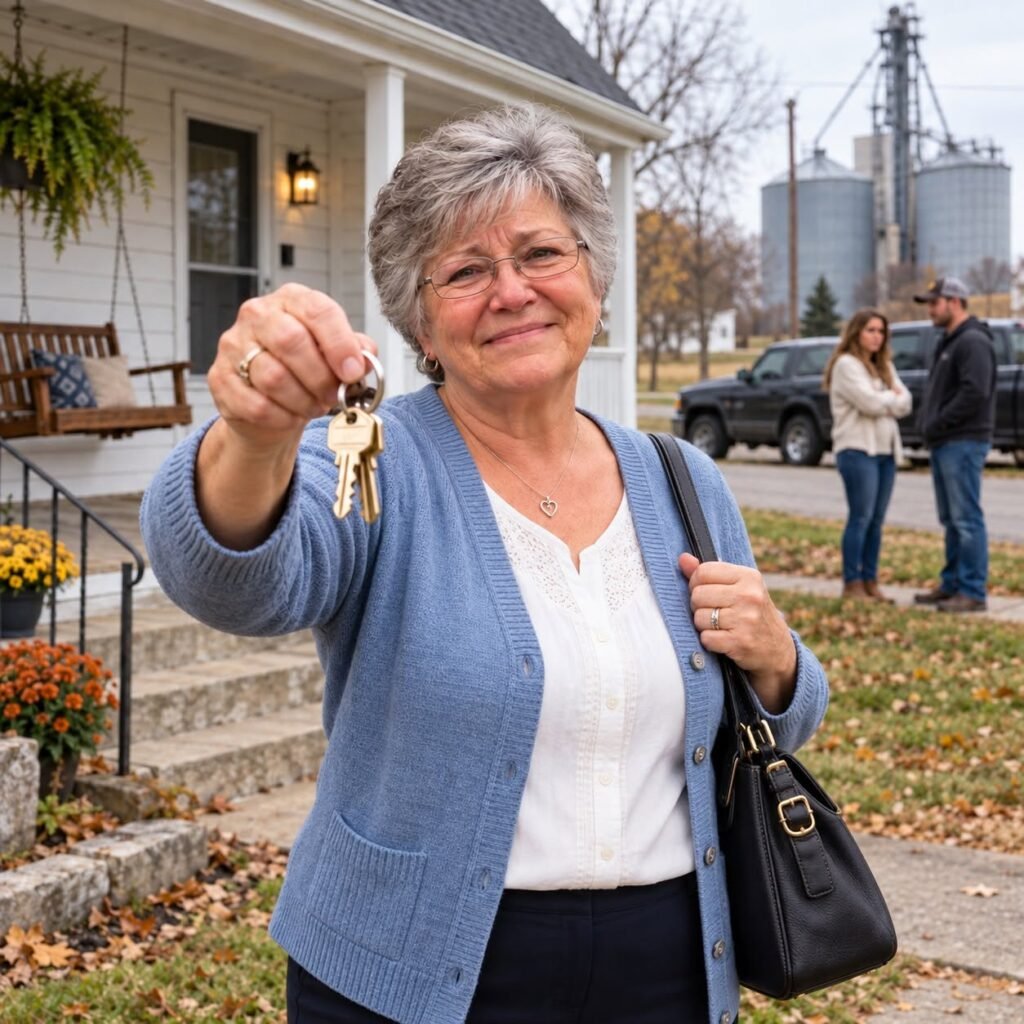
For a while nobody said anything. I was aware of my own breathing, and of the pot roast starting to catch at the edges in the oven, and of the porch swing outside creaking on its chains in the wind. Todd watched me the way a man watches a doctor who is holding an X-ray up to the light. I laid the photocopy flat beside the legal pad and smoothed it with the side of my hand. “Start at the beginning,” I said. “And don’t leave anything out because you think it’ll make me angrier. I will be as angry as I’m going to be.”
Todd rubbed his face with both hands. “Fourteen months ago the plant cut my hours. You remember. They said it was temporary, and it was, until it wasn’t. I went from forty-eight a week with overtime to thirty-two, and the house payment didn’t care. Michelle was working part-time and we were paying the day care, and I was robbing one bill to pay another, and I got scared.” He swallowed. “A man on my line told me about Pruitt Quick Cash. He said they didn’t ask a lot of questions. They didn’t, either. Not at first.”
“And me?” I said. “Where do I come in?” “Pruitt said my credit was too thin for the amount I needed. He wanted a second name on the note, somebody with steady income and no debts.” Todd’s eyes finally came up and met mine. “I thought of you. Steady check, nothing owed, never missed a payment in your life. I asked myself whether I should ask you, and I knew you’d say no, and I knew you’d say it kindly, and I couldn’t stand being told no kindly. So I didn’t ask.”
“So you signed my name.” It came out flat as a board. “I copied it,” Todd said. “From the estate papers. After Dale’s funeral you handed me that folder and asked me to look over the pension forms because you couldn’t make sense of them. You remember? I kept meaning to give it back. Your signature was on four of the pages.” He looked sick saying it. “I put tracing paper over one and practiced on the back of a feed-store receipt until it looked right.”
I have been angry before. I was angry at the doctor who said they had done everything they could, and angry at Dale for a week afterward for dying in March when the ground was too frozen to dig. This was something else. It did not flare up. It went cold and settled in my chest like a stone in a creek, and everything in the kitchen got very sharp: the water ring on the tabletop, the wet shine in Michelle’s eyes, the tremor of Todd’s fingers against his knee. A woman has only one name. He had borrowed mine like a wrench out of somebody’s garage and never thought to ask.
“Mom.” Michelle’s voice cracked down the middle. “I didn’t know. I swear on Sadie, I didn’t know until nine days ago. The morning after I hung up on you, a collection notice came to our house with your name on it, and I opened it standing at the mailbox, and I thought my knees would give.”
She pressed a fist against her mouth. “That’s why I never called. I’d just found out. How was I supposed to pick up the phone and say hi, Mom, how’s the new place, by the way, my husband forged your name?”
I looked from one of them to the other. A bookkeeper learns to hear when a number has been rounded off, and I heard it then, something in Todd’s story that was smooth where it ought to have been rough, a wall painted over a crack. I put it away to look at later. At that moment I only knew that two people I loved were sitting at my table with my forged signature between us, and that the pot roast was burning.
I stood. My chair scraped across the linoleum, and both of them flinched. “I want you to hear me,” I said. “I am not going to scream. I raised a daughter and buried a husband, and I know that screaming costs nothing and fixes nothing. In all our years Dale and I never put our names to a debt we couldn’t see the bottom of. And you took my name and put it on one you couldn’t.” My voice stayed level, which frightened me more than shouting would have. “Pick up your pad. Take your wife. And leave my house.”
“Mom, please,” Michelle said. “Now, Michelle.” I hadn’t used that voice on her since she was sixteen. Todd rose slowly and tucked the legal pad under his arm, and Michelle stood without moving toward the door, watching me as though I might take it back. I did not. I walked to the front door myself and stood with my hand on the knob. The evening air leaking in around the frame smelled of corn dust and
diesel.
We never got any further. Before they reached the door, headlights swept across my porch, white and sudden, and a car door shut with a soft, expensive sound. Footsteps crossed the boards. A man in a pressed gray coat climbed my single step with a folder in his hand, and through the screen, in the porch light, I could read the tab on it. It was my full name, typed out, middle initial and all.
He knocked twice on the frame of the screen door, politely, the way a salesman knocks. Todd went as white as the siding. Michelle’s hand found my sleeve and held on. I opened the door as far as my own shoulders and stood in the gap. The man on my porch was fifty or so, with a barber’s haircut and the kind of gray wool coat that stays pressed after a day of driving, and he smiled at me as though we had met at church. He said my name, all of it, and pronounced it right the first time. “Dennis Pruitt. Pruitt Quick Cash. I hope I’m not interrupting your supper.”
“You are,” I said. “I won’t keep you.” He tipped the folder against his forearm. “Todd was kind enough to tell me where you’d moved, when I couldn’t reach him at home.” Behind me Todd made a sound like a man who has stepped on a nail. “He called Tuesday,” he whispered, to nobody. “He said he only wanted to talk.” “I find a person is always more reasonable at her own kitchen table,” Pruitt went on, gently. “It’s a short matter, ma’am. There is a promissory note, executed fourteen months ago, with you as co-signer. With principal, interest, fees and rollovers, it stands today at thirty-eight thousand four hundred dollars.”
Thirty-eight thousand four hundred dollars. I did not let my face move. I have stood across a counter from men who swore a truckload of lumber had never been delivered, and I know the trick of it: the louder the number, the quieter you get. “That is a remarkable figure to hang on a paper I have never seen,” I said. Pruitt’s smile did not change. “People in your position often find that arrangements can be made. A woman on a fixed income, whose check arrives every month like clockwork at the same bank. It would be a pity if that routine were disturbed. Judgments have a way of reaching places people think are safe.”
Now, I took my share of telephone calls from collection agents on behalf of lumberyard customers, and I know a bluff by how hard it leans on a word like safe. A Social Security check is protected. A private lender cannot reach it, not with a judgment and not with a threat, and the people who say otherwise are counting on you not to know. “Mr. Pruitt,” I said, “you can’t touch my check, and you know it. You’re hoping I don’t.” Something moved behind his eyes, there and gone. I took it as a first payment on what he owed me.
“Then I’d like to see the original note,” I said. “I’d like to look at the ink.” “The original is kept at my office.” “Then I’ll look at it there, with my own lawyer.” “I don’t release originals, ma’am. Company policy. The copy is perfectly faithful.” He took a card from his breast pocket and laid it on the porch rail, squaring its edge to the wood, then set the folder on the porch swing beside it. “ Copies of the statements, for your files. You have until the first of the month to make arrangements. After that I proceed, and I’m afraid I proceed in earnest. My regards to the family.”
He walked down my single step, got into a long gray car, and backed out of the drive without any hurry at all. The first of the month. I stood there with the screen door against my hip and let that sink in. The first was the same day I had to hand Caleb Olson the keys to the farmhouse. Whoever had chosen it either hadn’t known or knew exactly what he was doing, and I could not tell, standing in the dark with the taillights shrinking toward the elevator, which of the two I’d have preferred.
The card was heavy cream stock with raised black letters: PRUITT QUICK CASH, Cash When You Need It Most,and under that, Dennis Pruitt, Proprietor, and a telephone number. In smaller type at the bottom it said Licensed and Bonded. I turned it over, and the back was blank. A man who raises the word licensed in ink on his card is a man who wants it believed. I put the card in my cardigan pocket anyway, and I picked the folder up off the swing, and it was heavier than a folder that thin had any right to be.
We went back inside, all three of us, and nobody sat. I set the folder beside the legal pad, two halves of the same business, and stood looking down at them with my hands on the back of a chair. The lamp over the stove made a yellow circle on the linoleum, and Todd and Michelle stood at the edge of it like people afraid of thin ice.
Todd broke first. “Judy, it’s mine,” he said. “All of it. I’ll go see him tomorrow and sign whatever he puts in front of me. I’ll tell him I forged it, I’ll tell him Michelle had nothing to do with any of it. I’m the one who took out the first loan, I’m the one who started it, I’m the one who—” “Todd, stop.” “No, listen to me, Judy, she didn’t know, she was never—” “Stop it.” Michelle’s voice had gone flat and strange. She stood with her arms wrapped around her own ribs, looking not at me but at her husband, and the tears had stopped as though somebody had turned off a tap.
“You’re lying, Todd,” she said quietly, “and you’re lying for me, and I can’t let you.” She turned and looked at me, finally, straight on, the way she hadn’t since she was a child standing over
a broken lamp. “The first loan wasn’t Todd’s, Mom,” Michelle whispered. “It was mine. I borrowed it for Daddy.”
Continue reading on the next page ↓
