Nobody spoke. The pot roast had burned past saving, and I turned the oven off and left the pan where it sat. When I came back to the table Michelle had pulled her sleeves down over her hands the way she did at nine years old, and Todd had one palm flat against the small of her back as though he were afraid she would blow away. “Tell me,” I said. “All of it, from the beginning. I won’t interrupt.” She took a breath so deep it shook.
“About a week after the funeral, there was a letter. I drove out to water your plants while you were at the church luncheon, and it was in the farmhouse mailbox. From a collection agency. Nine thousand three
hundred dollars, Mom. The balance the hospital said insurance hadn’t covered, from his last two admissions. The ones he told us were tests.” She stared at the tabletop. “He must have known for a long time, and he never said a word to either of us.”
“So I took it out of the box. And the next one, and the one after that. I drove out every Tuesday with Sadie in her car seat, and while you put the kettle on I’d walk down the lane to check the mailbox.” I remembered those Tuesdays. I had thought my daughter was being dutiful. My gratitude turned over in me now like a stone in the garden, the wrong side showing. “You’d just buried him,” Michelle said. “You were sitting there with your hands in your lap, and I thought, I’ll fix this, and she’ll never have to know.”
“The agency said a lien, a judgment, they said they’d go after your check.” Michelle gave a wet laugh. “I didn’t know you can’t. I didn’t know anything. A girl at the bank told me where to go for fast money, and I walked into Pruitt Quick Cash on my lunch break and signed a paper I didn’t read. He handed me nine thousand three hundred dollars in a bank envelope. I paid the hospital in full that afternoon. I got a receipt. I felt like I’d saved your life.” “And then it kept growing,” I said. “Every month,” she whispered. “I paid and paid, and the number never went down.”
Todd took it from there, in a voice with the stuffing out of it. He had found Pruitt’s statements in the glove box of Michelle’s car the same month his hours were cut, and he hadn’t shouted, he had only sat in the garage for an hour. “This is the part I left out before,” he said. “I thought I could fix it. One bigger loan to pay off the old one and the late fees. Pruitt said he’d do it if there was a second name. Every time we got a little ahead, he rolled it, and we were right back where we started. That’s why I came up with the eight hundred. If your check came in, we could keep up, and nobody would ever have to confess a thing.”
Three grown people at a kitchen table, and in every one of us a drawer we had kept shut. I sat very still. Part of me wanted to put my arms around my daughter, and part of me wanted to put her over my knee, and the bookkeeper in me wanted neither; she wanted the paper. I stood and said, “
Go home. Relieve whoever is watching those children and put them to bed. Leave me the pad, the statements, and every scrap you have.”
Michelle went out to the truck and came back with a paper grocery sack rolled at the top, and she set it on my table as though it were hot. Then their taillights swung across my kitchen wall, and the house went quiet. I spread everything out: Pruitt’s folder, Todd’s pad, thirty-odd statements, notices and receipts, soft at the corners from being handled. I fetched the old ten-key adding machine I had taken home when the lumberyard went to computers, and the stub of Dale’s carpenter’s pencil, and put on a fresh pot of coffee. By midnight the table was a map.
The interest came first. The note listed a finance charge of 9.8 percent per month, printed in type meant to be skimmed. Nine point eight times twelve is a hundred and seventeen point six, and with what the fees did to it, near enough to 118 percent a year. I didn’t have to look up the legal limit. A rate like that isn’t a rate. It’s a theft with a decimal point. Then the rollovers, three of them, each dated before the payment it supposedly rolled had come due. One was dated the fourteenth for a payment that, by the bank stamp on Todd’s own receipt, hadn’t gone in until the twentieth. Add up all the cash that ever left Pruitt’s drawer, Michelle’s $9,300 and Todd’s $8,300, and it came to $17,600. The paper said $38,400.
That left the signature page. I laid the photocopy under the lamp, and my forged name leaned the way mine leans, looped J and all. Beside it, in the margin, was a round gray smudge where someone had pressed a notary stamp. The rollover pages carried the same stamp, pressed cleaner. There was no witness line and no record of anyone appearing, nothing to say a living soul had watched the signer sign. A notary who doesn’t see the signer is no notary. He’s a rubber stamp with a pulse.
By two in the morning the coffee was cold and my eyes burned. I took the magnifying glass from the junk drawer, the one I had used on Dale’s pension forms, and bent over the cleanest impression, on the third rollover. Around the ring it said NOTARY PUBLIC, and across the middle, in capitals so crisp they might have been pressed that morning, was a name. I read it twice. Walter Brandt. The man who had handed me two keys on a metal ring. The man who had taped Ask Brandt beside his cash register in his own square handwriting.
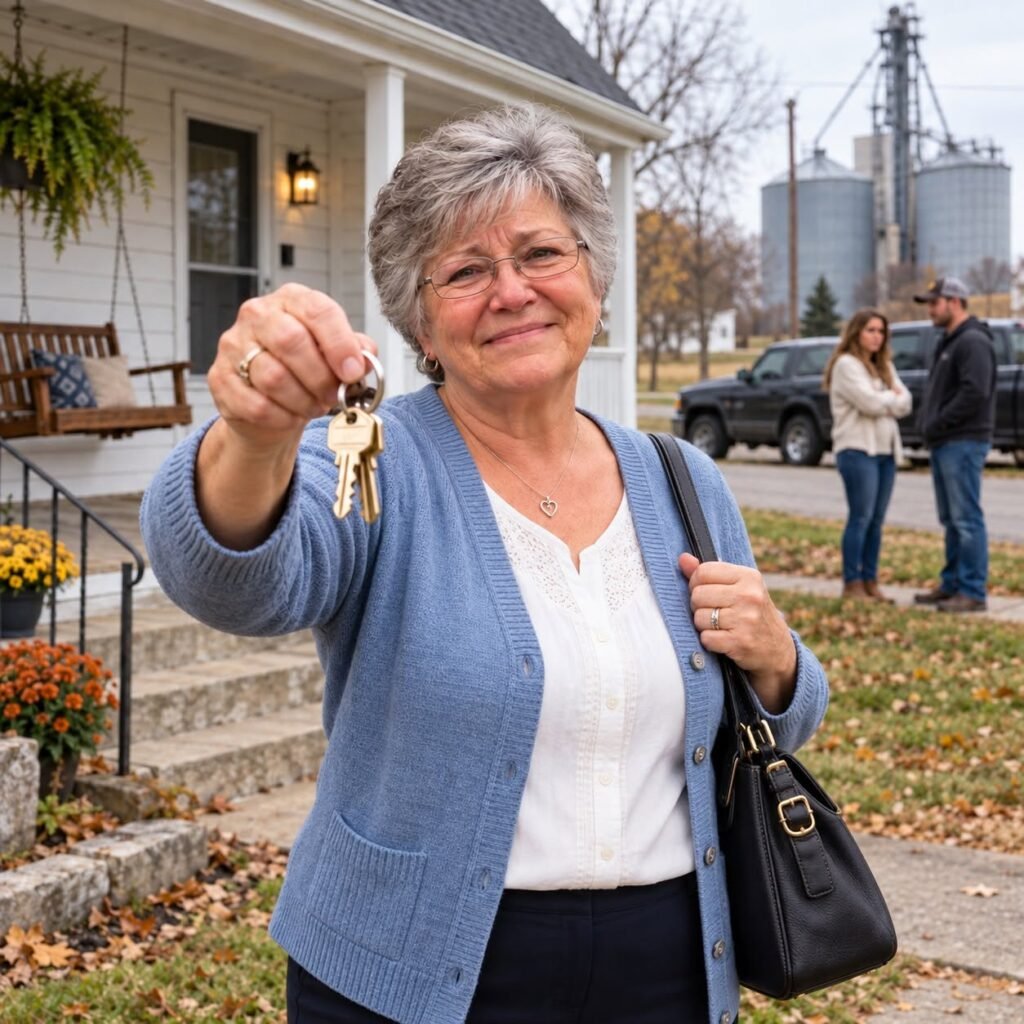
I sat with that stamp under the lamp for a long while. The ink had gone a little purple at the edges, the way cheap stamp pads do, and the name inside the circle did not change no matter how many times I read it. Walter Brandt, Notary Public. That same man had handed me two keys on a metal ring and apologized for the corn dust. I made a pot of coffee I didn’t want, and when the window over the sink turned gray I washed my face, put on my good cardigan, and slid the photocopy into my purse, where Todd’s yellow legal pad already lay.
The feed store opens at six-thirty during harvest, and I was parked out front at ten after, with the Buick’s engine ticking and my hands folded on the wheel.A grain truck rumbled past toward the elevator. On the half hour Mr. Brandt came around the side of the building with his key ring, saw my car, and stopped walking. I watched him decide whether to wave. He didn’t. He unlocked the door, switched on the lights, and left the door standing open behind him, which I took for the only invitation I was going to get.
Inside, the place smelled like molasses and sweet feed and rubber boots, the same as it had for twenty years. The notice he’d taped beside the register was long gone, but four small squares of yellowed tape still marked the wood. I walked up to the counter, took the photocopy out of my purse, and laid it flat between us. I didn’t say a word. Two decades of bookkeeping had taught me that a man will fill a silence faster than you can fill it for him.
He put on the glasses that hung from a cord around his neck and read the page top to bottom, then bottom to top. When he reached the stamp at the foot, the color left his face so fast I put a hand on the counter myself, thinking he might go down. “Sit,” I said, and pointed to the stool behind the register. He sat. For a minute the only sound was the compressor on the cold case kicking on.
“That’s my stamp,” he said at last. “I never witnessed that, Judy. I never saw the man who signed it, and I never saw you. I want you to hear that first. Dennis Pruitt holds the note on this store. I borrowed from him four winters ago, when the co-op undercut my prices and I couldn’t make payroll, and he has rolled it over so many times I owe more than the building is worth. Once a month he comes in with a stack of papers. I stamp them. No signers, no witnesses, nothing written in my book. Dozens by now. Maybe more.”
I did the arithmetic without meaning to: how many kitchen tables, how many people who thought they’d signed for a few hundred dollars and had really signed themselves over to Pruitt. “And you stamped the one with my name on it,” I said. “I did.” He rubbed his face with both hands. “I saw Dale’s widow’s name on Todd’s note and I couldn’t stand it. Dale paid his account here on the first of every month for twenty years, never short, never late. I stamped it anyway, because I was afraid, and then I went home and couldn’t eat my supper.”
“Is that why the notice?” I asked. “I know about your farmhouse. Everybody does.” He looked at the old tape marks instead of at me. “That house would rent for seven hundred easy. I kept it at five-fifty and put the sign where you’d see it, because I figured sooner or later somebody would come asking questions, and I hoped it would be somebody who could read a column of figures.” I thought of those three weeks that paper had hung beside his register, and of how nearly I had walked past it.
“I’m sorry,” he said. “I’m sorrier than I know how to put.” I let that sit where he’d set it down. A woman my age is trained from girlhood to say it’s all right across a counter, and it wasn’t all right, and I was not going to say so just to make his morning easier. “I heard you, Walter,” I said. “That’s all I’ve got for you today. Don’t mistake it for more.” He nodded the way a man nods when he’s handed a bill he knows he has coming.
Then he did something I didn’t expect. He got up, went to the front window, turned the sign from Open to Closed, and came back with his hand on the counter to steady it. “There’s something else,” he said. “Years ago, when Pruitt first started leaning on me, I took a copy of his private ledger. He keeps it in a duplicate book, in his own hand, because he’s the kind who can’t leave off writing down what he’s got. I lifted the duplicate from his back office one night he left the door unlocked. I told myself it was insurance. Then I got scared of it and never did a thing with it.”
“Where is it?” I asked. He took so long to answer that I heard the compressor cycle off again. When he spoke, he lowered his voice as though Pruitt might be standing behind the sacks of layer pellets. “I own that little house, Judy. I put it where nobody would think to look. It’s been in the crawl space since before you moved in, under the hatch in the floor of the back closet.” He swallowed. “And the first name on page one is Dale’s.”
Continue reading on the next page ↓
