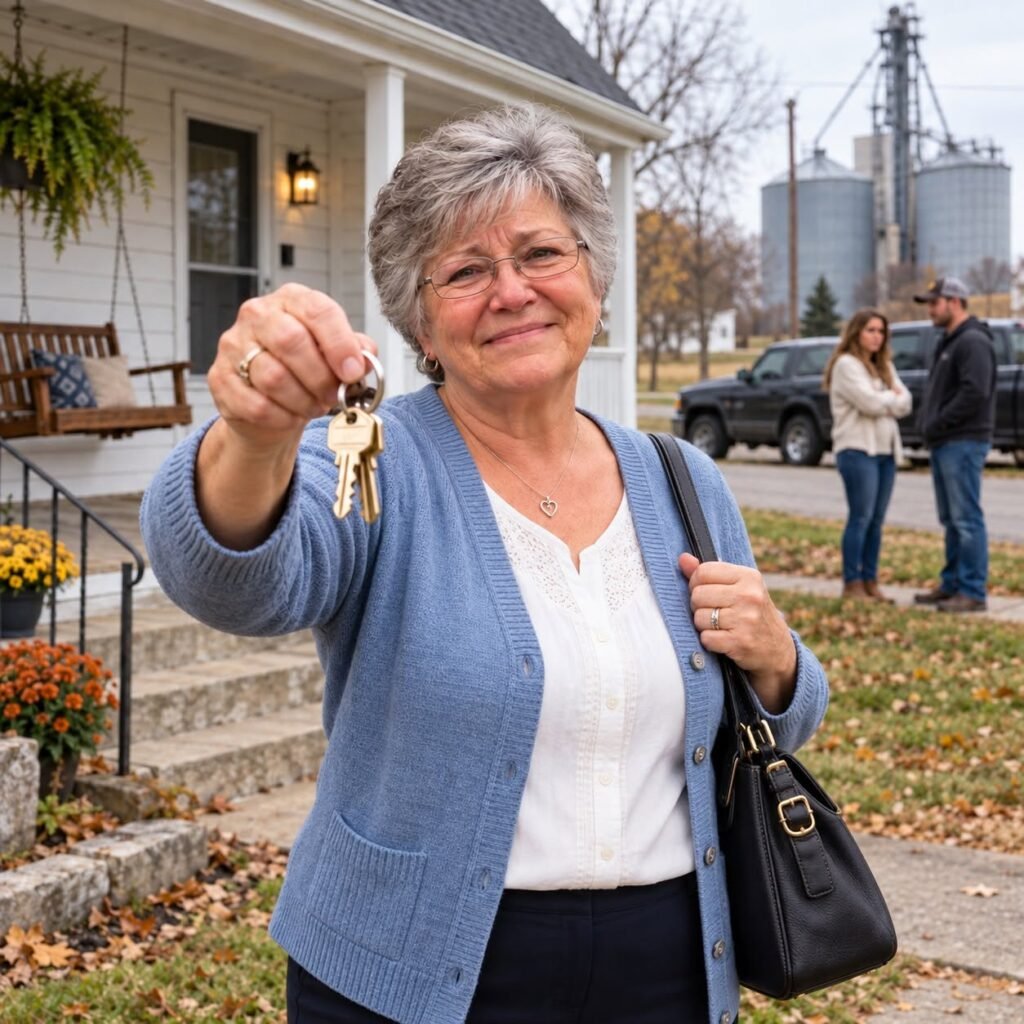
The hatch was exactly where he said, a square of plywood in the floor of the back closet with a brass ring set flush in one corner. I had hung my winter coats over it for two weeks without once wondering what lay underneath. I got down on my knees, which have opinions about that, and hauled the plywood aside. Cold air came up smelling of dirt and mouse and old pipe. By the beam of the flashlight from my glove box I saw the furnace squatting in its corner wearing a fresh filter, the paper still bright white, which I put down to Walter being a tidy landlord.
The box sat against the foundation wall, wrapped in a feed sack and tied with baling twine. It was rusted steel, about the size of a bread box, and it weighed more than it looked. I dragged it across the dirt, heaved it up through the hatch, and carried it to the kitchen table with my arms shaking from more than the weight. The latch had rusted shut, so I worked it open with a butter knife. Inside, on a folded dish towel, lay a green clothbound ledger, the same brand I had bought by the case for the lumberyard.
I turned back the cover. The first page was ruled in red and blue, and the handwriting was small, slanted, and tight. The first line read: Dale, hired man, Olson place. Fifteen thousand dollars, spring of 2019. Purpose: daughter’s down payment. Beside it, in the next column, a monthly figure: $190. I put my finger under that number the way I used to on the lumberyard’s long Friday tallies and followed it down the page, month after month, every one marked paid, until the last, in March, the month Dale died.
Dale had never told me. For six years he had peeled a hundred and ninety dollars a month out of a hired man’s wages, and I, who could find a missing dime in a month of invoices, never saw it go. I remembered the coat he wore three winters past decent, and the Saturdays he hauled hay for neighbors and came home with chaff in his cuffs. By my arithmetic he had paid better than thirteen thousand on a loan of fifteen, and Pruitt’s book still carried the principal forward, rolled over again and again until it stood at more than twice what he borrowed. Under the last payment Pruitt had written: Dead. Note stands. Lien on daughter’s house.
I wanted to be angry with him, and I tried. I waited for it the way you wait for a bill to come due. What came instead was Dale at our own kitchen table in the spring of 2019, saying the girl’s getting a house, Judy, and me saying isn’t that something, while he kept the one fact that mattered folded up in his shirt pocket. He had done it out of love. That was the worst of it. It was the same wrong thing everybody does, only with a better reason.
So that was how an old note had come to hang over Michelle’s house. I put my hands flat on the cloth cover and thought about my mother, who kept egg money in a coffee can behind the flour and never told my father it was there. I thought about Dale and his hay money, Michelle and the farmhouse mailbox, Todd practicing my looped J, and my own nine days of keeping a rented house to myself. Three generations of us, and not one had ever said a number out loud at a table.
I should have closed the book then. Instead I turned pages, and near the end of the last year of entries I found a line in the same slanted hand, dated last spring. Get the widow under Todd’s roof. Collect $800 monthly there. I read it four times, the way I would read a bank error. The paper Todd slid across Michelle’s table had never been about a basement room. It was about my check, and somebody else had been holding the pencil.
I carried the ledger out onto the porch for air, and there was a pickup at the curb and Todd on my single step with his elbows on his knees. He had taken the day off from the plant, he said, and wanted to know if there was anything at all he could do. Then he saw what I was holding. “Read the first page,” I said, “and then the one I’ve got my thumb on.” He read both with his lips moving. “Eight hundred,” he whispered. “He gave me that number, Judy. He said it would keep him off the plant. I thought it was mine.”
“It was his from the start,” I said. “Drive me to your house. Michelle needs to see this, and I’m not fit to hold a steering wheel.” Todd’s pickup smelled of coffee and machine oil. He drove with both hands at ten and two, and I held my purse in my lap with the ledger inside, as though it were a casserole I was afraid to tip. Twice he started to speak, and twice I told him to save it for his wife. Main Street slid by, the courthouse flag, the bank, the café where Dale never once ate breakfast.
I was still working out what I’d say to my daughter when the phone buzzed in the cup holder. At the red light on Fourth, Todd glanced down, and I watched the blood leave his face all at once. He passed it to me without a word. The sender was saved only as a single letter, P. The message read: “I’m at your house. Your little girl answered the door.”
Todd ran two lights and a stop sign I would have sworn was only advice. He called Michelle three times on the speaker, and three times it rang through to the machine, and I knew without being told that she was in the basement with the washer thumping and the dehumidifier humming, thirteen stairs below any doorbell. I kept the purse in my lap with both hands. The ledger sat in it against my ribs, heavier than any book that size had a right to be. When the pickup bumped the curb in front of the house, Todd was out of it before it stopped rocking.
The front door stood open a hand’s width. Inside, the kitchen smelled of coffee that nobody who lived there had made. Dennis Pruitt sat at the head of Michelle’s table with his pressed gray coat folded over the chair back, a mug at his elbow, and his folder squared against the edge of the oilcloth. He was a trim, pink-scalped man, and he looked like somebody’s favorite deacon. Beside him on a booster cushion, Sadie was coloring a purple horse with her tongue between her teeth. Michelle sat across from them with her hands flat on the table and a laundry basket on the floor behind her chair, one small sock lying on top.
“Grandma!” Sadie held up the horse. “The man says he’s friends with Daddy. He likes my purple.” “It’s a fine purple,” Pruitt agreed, and smiled at her with every one of his teeth. Michelle lifted her eyes to mine, and I have seen that face on exactly two other occasions, both in hospital corridors. “Judy. Good,” Pruitt said. “Todd, shut that door, would you? There’s a draft. Sit down, both of you. By now we’re practically family.” Todd shut the door because he could not think what else to do with his hands.
I sat, because the child was there and I did not intend to stand over her like a thundercloud. Pruitt opened the folder with two fingers. “I’ll keep this brief. I have here a note for thirty-eight thousand four hundred dollars with your name on it. You say you never signed it. Fine. Sign a new one, in your own hand, today, properly drawn, and the old paper goes in the stove. Nobody ever has to wonder whose hand wrote what. Mr. Brandt will be glad to stamp it.” He said that last part pleasantly, and I felt it land on the back of my neck.
“And if I don’t?” I said. “Then the old paper goes to the county attorney tomorrow morning, with a complaint that has Todd’s name on it. Forgery is a felony, Judy. The plant doesn’t keep felons, and prison doesn’t pay a wage.” He turned his head toward the crayon box, and his voice stayed as soft as a minister’s. “I’d hate for that little girl to learn the word restitution before she learns to read. And you would still owe me, and a woman on a fixed income has so few places to look.”
“Is somebody in trouble?” Sadie asked, not looking up from the horse. “Not a bit, sweetheart,” Pruitt said. “Grown-ups are only talking about numbers.” I wanted to tell her that numbers were never only anything, that I had spent my life watching what they did to people when they were left to pile up in the dark. Instead I folded my free hand over hers. Her small fingers were sticky with crayon wax, and they were the steadiest thing in that room.
I did what I’d done for twenty-two years across the lumberyard counter when a contractor swore an invoice never came: I kept my face still and let him finish. In my lap my hand had found the clasp of my purse, the same brown purse I had tucked Todd’s notebook paper into at this very table, and through the leather I could feel the corner of the ledger. Dale’s name on page one, and Pruitt’s own hand on the subject of my check. I could have said so right then. I did not. A woman who lays her whole hand down for a man like that has no hand left.
Michelle was looking at me. She didn’t say anything, and she didn’t have to. It was all in her swollen eyes, begging as plainly as if she’d gone down on her knees on the linoleum: please, Mom, just sign it, just make it stop. Todd shook his head hard. “Don’t,” he said, and his voice cracked in the middle. “Judy, don’t sign anything. Whatever he does to me, I earned it. You don’t put your name on his paper.” “Todd,” Michelle whispered. “Quiet, both of you,” Pruitt said, almost kindly.
Under the table a small foot swung and tapped my shin. “Grandma, you can color too,” Sadie said, and she slid a green crayon toward me across the oilcloth. I looked at the crayon, and the folder, and the girl’s bent head, and I thought of the thirteen stairs and the cake-pan window and every way there is of being made to feel small in a house that isn’t yours.
Pruitt unclipped a gold pen from his shirt pocket, thumbed off the cap, and laid it on the page he had set in front of me. Then, with one finger, he slid it across the oilcloth until it came to rest against my knuckles. It was warm from his body. Across the table I heard Michelle stop breathing. And with the whole kitchen watching, I picked it up.
